

April 18, 2026
- Belgian Nursery
- 0
- 528
- Annual, Cacti & Succulents, Garden, Houseplant, Perennial, Plant, Seed Starting
Plant Pics Online: Fact or Fiction?
The internet is an amazing thing, able to bring thousands of images to our screens with just a few taps on the keyboard. And now with AI (Artificial Intelligence) we all have access to whatever we can imagine! Want to make a crocodile walk upright on the runway at Fashion Week? That’s easy! Want to see what a hosta-lupine hybrid would look like in the garden? Sure, that’s possible, and it looks so real…wait, is it real? (Spoiler: it’s not real).
That’s the thing with AI-generated pictures: photo-realism. Back in its early days it was easy to pick out the fakes, with all those six fingered people and extra eyebrows. Now we have to squint for discrepancies, like a bad game of Where’s Waldo but with obscure watermarks instead of happy hikers. And the gardening world is no exception to these types of photo-realistic creations, ranging from simple colour changes to complete species overhauls. So which photos in your internet search engine are real, which ones are imagined, and how do we tell the difference?
Blinding Colour Schemes
The natural world holds some of the most amazing hues, and even offers 2, 3, or more colour combinations within a single leaf. But these tones are typically down-to-earth (with some exceptions) and blend into each other with a natural flow. Compare these to AI generated plant photos – yes, that bright neon purple calathea is dazzling and the rainbow patterns on that one hosta picture are stunning, but they also feel like you’re staring into the sun. Insects can see ultraviolet light, not the human eye and not the average camera lens.
Speaking of Insects…
Most plants attract bugs of some kind at some point in their lives, whether it’s the nectar hidden in their blooms or the tasty snack that is their leaves. And those little snackers will leave evidence behind, like half-eaten foliage or snapped stems. These may not be pretty, but they are proof of life along with uneven growth, wilting leaves, and faded flowers. The natural world is wild and resilient; perfect symmetry is not high on its priority list.
Weird Combos
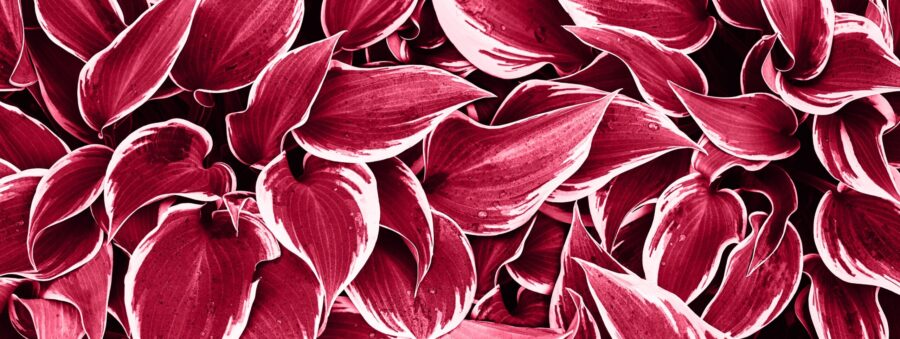
The fake “hosta-lupine” photo that was mentioned earlier was actually the inspiration for this entire blog! We’ve had so many customers asking for the “red and white hosta with bushy flowers” that, sadly, does not exist in real life. It doesn’t take much to change colour saturations on leaves, or copy-and-paste blooms from one species onto a completely different plant. But a cluster of roses shaped like kittens and blooming from a Monstera? Highly suspect, and deserving of a reverse image search or, at the very least, a check-in with your local garden centre.
Check the Credits
Working in a greenhouse means playing in dirt and speaking Latin, and while that last bit may seem a bit odd it’s very important to our job and your gardens. All living beings, from giant whales to tiny mosses, are classified using nomenclature. This biological system has been used since the 1750s, using Latin ‘genus’ to distinguish a Peace Lily (Spathiphyllum) from a Calla Lily (Zantedeschia), and ‘species’ to further separate the African Marigold (Tagetes erecta) from the French Marigold (Tagetes patula). A verified plant photograph or drawing will have its genus and species listed in the caption; an AI-generated picture may have a nonsensical name or no name at all.
Even Seeds Aren’t Safe, It Seems
Online seed packet sales have increased dramatically over the past decade. Everyone from big conglomerates to neighbourhood home-growers are offering seed varieties for every price range, and of course they include photos of the “finished” product. But if those photos fall into any of the above categories, they’re most likely fake which then begs the question: what are you really getting in that packet? At best it could be a common flower, at worst an invasive species – there are even reports of people receiving nothing but bits of sawdust! To save your wallet, your gardens, and the environment at large, be sure to buy your seeds from reputable sources.
The Best Rules to Follow
Keep your wonder of the natural world. Find beauty in imperfections. Look for the Latin. And if it looks too good to be true, it probably is.
-This blog was written using research and information from reputable online sources, as well as the author’s own command of the English language.
Post Views: 528